Blog
Credit note - what do I need to keep in mind when issuing one?
Katharina Theo Rösner



Settlement credit notes are a specific type of invoice subject to fixed requirements under the Value Added Tax Act. Find out what you need to keep in mind when issuing credit notes here.
Credit notes, also known as settlement credit notes, are regulated in the Value Added Tax Act (Section 14 (2) UStG) . They are also referred to as reverse invoices issued by the recipient of the service to settle the services provided. In the classic scenario, the service provider also issues the invoice. Credit notes are part of the invoicing process and should not be confused with cancellation invoices or correction invoices. The Value Added Tax Act defines them as reverse invoices. They must be GoBD-compliant and kept for 10 years. The amount is always positive.
In artistic trades or for freelancers it is common for contractors to provide a service. Instead of issuing an invoice, the recipient of the service then issues a self-billed invoice. The liability accordingly arises for the companythat receives the service.
This type of billing must be agreed upon in advance. The self-billing procedure has the advantage that the service provider receives the money faster. This is because they do not have to take the time to write an invoice. Conversely, the company receiving the service does not have to verify the invoice and therefore has less administrative work.
The contractors check the credit note only for accuracy, for example whether the VAT rate is correct. For small business owners, for example, VAT is not charged. If the credit note is incorrect, the recipient must object to it so that it loses its validity.
This is relevant because tax liabilities can arise with the tax office if the VAT is not stated correctly.
The VAT is reported by the issuing company in the VAT return as input tax, which reduces the tax payable.
The mandatory requirements are the same as for an invoice, as a settlement credit note is a special form of invoice.
The term credit note only applies to self-billed invoices.
Referring to commercial credit notes and bank credits as simply "credit notes" is colloquial, as there are precise legal requirements for these terms.
Commercial credit notes are cancellation invoices or invoice corrections, which are issued when the payment amount has changed due to defects, goods are returned, or if too many goods were supplied.
If too much money was transferred, it is a bank credit. It includes all Booking amounts that are credited to an account.
Bank credits are always associated with negative invoice amounts, which contradicts the requirement that credits must have a positive value.
They are recorded as an invoice on the recipient's side. On the service provider's side, credits are recorded as revenue or income. You can find more information at Lexware.
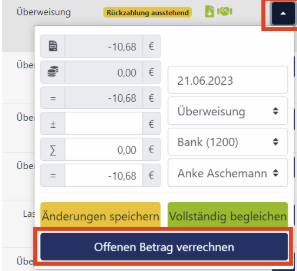
For this reason, the term "credit" does not exist in your FrachtPilot cockpit. Instead, you send an invoice with a negative amount. Once created, it is immediately assigned the status "Refund pending." The process works as follows:
You can find out more about this in the FrachtPilot help center ..
You can add credit under Invoices in the admin overview by, selecting the option 'offset open amount' for invoices with the status 'Refund pending' and entering a negative amount.
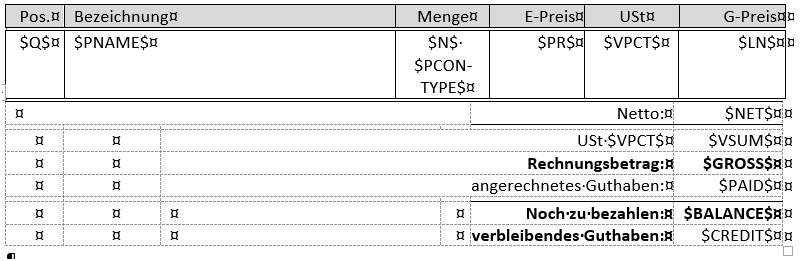
In the company profile templates or customer settings you can invoice documents using the INVOICE key text snippets to add in order to credit notes correctly configure. This includes, for example, $PAID$ for the credit, which is shown on the invoice as applied. In addition, $BALANCE$ for the remaining amount after the credit has been applied, as well as $CREDIT$ to indicate the remaining credit balance. You can read more about this in our help center:

Since credit notes have the same legal requirements as invoices, they are not listed as separate templates in FrachtPilot; instead, they are categorized under invoice documents. Rather than being labeled as a credit note, a document is issued as an invoice with a negative amount. The credit to be recorded is essentially a bank credit. Cancellation invoices can also be created as commercial invoices. However, these are primarily used for complete and transparent bookkeeping documentation in the event of incorrect invoices. Refunds are not the same as reimbursements.
Beyond invoicing, FrachtPilot offers even more top features that you need for your regional direct marketing of food products, such as stand management and route planning. If you are still looking for a suitable ERP system for your direct marketing business, why not take a look at FrachtPilot over, test our software for 30 days for free or book a free webinar to get to know us and the system. We look forward to seeing you!