Blog
Payment reminders: what to do when customers don't pay?
Katharina Theo Rösner



The receivables management and dunning process are handled by the accounting department or accounts receivable. This department creates customer accounts with customer numbers and is responsible for sending out payment reminders and dunning notices, as well as recording and posting incoming payments and receivables. We provide an overview of what you need to keep in mind regarding the dunning process.
Unlike a dunning notice, a payment reminder has no legal consequences. Therefore, it is not strictly necessary to send business customers a payment reminder after the payment deadline has passed.
The difference between a payment reminder and a payment tolerance is that the latter is an internal buffer. This means that customers only receive a payment reminder once they exceed the payment deadline by four days.
Payment default on the other hand, means that the delay is at least 30 days. However, if a binding payment deadline is contractually agreed upon and not met, the debtor is automatically in default – even without a formal notice.
Debtors (from the Latin debere 'to owe') are the Debtorswho have outstanding receivables from a company. These are recorded in accounts receivable. A separate, individual account receivable is created for each customer to track payments and receivables, as you can read about at Abilita . The counterpart to the debtor is the creditor, or lender. These can be, for example, suppliers to whom a business customer owes accounts payable for goods and services . These are recorded in accounts payable. Accounts payable accounting therefore deals with the liabilities of a business.
At the end of the fiscal year the total of all accounts receivable is compiled into the receivables, which can influence liquidity . The balance sheet ratio is the days sales outstanding. This expresses the ratio between accounts receivable and sales revenue in days. It is better for a company if this figure is low. Bad debt losses are also identified when preparing the balance sheet if trade receivables remain outstanding, resulting in losses.
In FrachtPilot you can configure automatic creation and delivery of payment reminders once the payment deadline has passed. This is usually 14 days. If payment is not received, the first reminder is sent four days later.
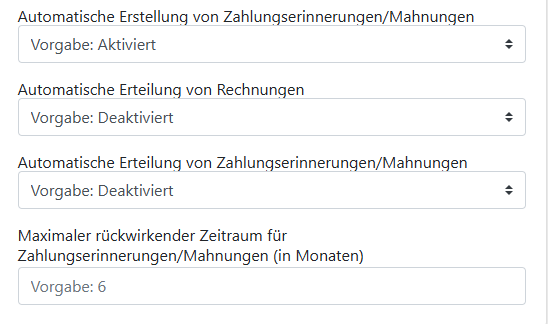
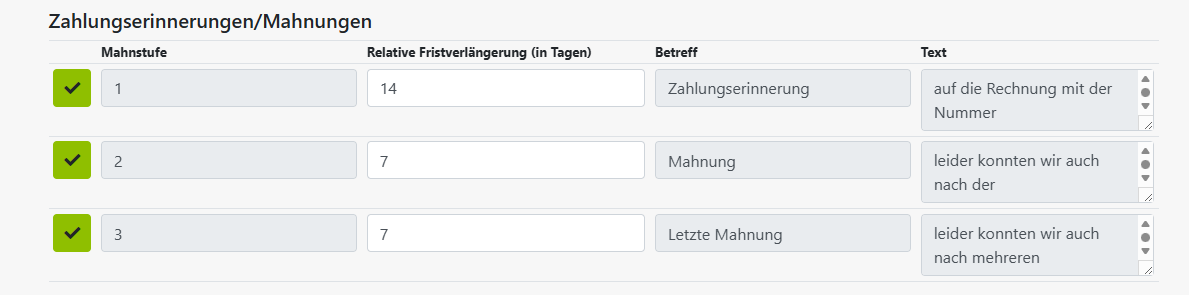
The dunning process FrachtPilot uses a three-stage process, which means that after the payment reminder with a new due date, the first formal notice is sent, followed by a second one if necessary.
Starting with the first notice, late fees can be charged, though only to cover costs such as postage. For business customers, a late payment fee of €40 can be charged under Section 288 (5) sentence 3 of the German Civil Code (BGB) as well as default interest. The latter can also be charged to private customers. When it comes to fees, you should always ensure they are reasonable.
Only after the second notice can legal proceedings be initiated. Fees should only be charged once, and you should always consider your relationship with the customer and the individual circumstances involved.
The tone of a payment reminder should be as friendly as possible, because customers often do not miss payments intentionally, but rather forget or encounter technical issues. The prerequisite a valid payment reminder requires that the invoice has been correctly issued and sent.
The text for the payment reminder can be customized in the invoice settings of the customer profile. Payment reminders require the following information:
Non-paying customers can be business or private clients who have forgotten an invoice or have not received it due to technical reasons.
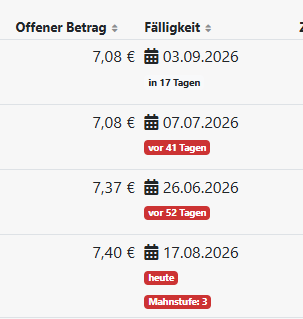
In FrachtPilot, you can also go to Customer Transaction Data > Invoices to see which payments are still outstanding from which customers.
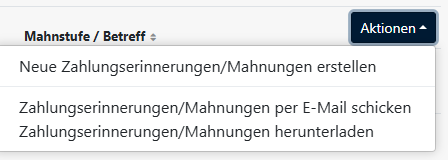
In Customer Transaction Data > Payment Reminders/Dunning Notices you can create new payment reminders. You can also send, download, or delete individual or all dunning notices:


If customers after receiving a dunning notice still do not pay an outstanding invoice, debt collection proceedings can be initiated. The term "Inkasso" comes from the Italian incassare and means ‘to collect’. The process is initially out-of-court, specifically in the pre-litigation phase, during which the debt collection agency attempts to obtain payment from the debtor. If the debtor does not respond, an application for a dunning notice can be filed with the local court . This contains the details of the creditor, the debtor, the amount of the claim, and the due date, as you can read about at Sparkasse .
In the litigation phase, the customer can pay or file an objection within two weeks. If neither happens, it can lead to an enforcement order . In the event of an objection, the creditor initiates court proceedings.
In the post-litigation phase, garnishment may occur if the debtor is unable to pay the amount.
The judicial dunning procedure can only be initiated if the customer does not respond to the payment reminders at all. This has the advantage that it can be conducted without a lawyer and is both more formalized and less expensive than a lawsuit. This is explained by debt counseling services.
You should carefully consider whether it makes sense to hire a collection agency. You should take the amount of the outstanding debt into account. Although it is an out-of-court process, you should still wait to see if a customer might eventually respond to the reminders and pay. If you are dealing with customers who regularly fail to pay, you should take other steps, such as involving a lawyer or deactivating the customer to prevent further unpaid invoices.
If you receive a collection letteryourself, you should checkwhether you can identify the claim and the company or person, and whether you might have already paid it.
If it seems suspicious, you should Google the company to see if it is a scam. In that case, you should definitely not pay anything, ask questions, or simply ignore it. You should always report a suspected scam.
If the claim is legitimate, however, you should always pay immediately. If the claim dates back a long time, you can also file an objection, as they expire after 3 years.
In a collection process the collection agency acts as an intermediary between creditor and debtor and ensures that high costs are avoided for both parties. For this purpose, you should hire a reputable collection agency that adheres to the industry code of conduct holds. It first determines why the customer is not paying by analyzing the order situation, liquidity, and profitability.
In a successful case, the debtor pays the outstanding amount to the collection agency, including collection fees. The agency then forwards the payment to the creditor. A claim can become statute-barred after three years, with the period beginning at the end of the year in which the claim arose. Once a claim has expired, it can no longer be collected.
The commissioned collection agency can also initiate a garnishment if a customer does not object to a legitimate payment reminder and is insolvent.
There can be various reasons for non-payment. Before sending payment reminders, you should check the invoice for errors. Only then is a formal reminder justified. Before taking further legal action, an out-of-court solution should be sought. A three-stage dunning process, as used by FrachtPilot, is ideal for this.
In addition to dunning, FrachtPilot offers other functions such as accounting, inventory management, and route planning. Are you still looking for a suitable ERP system for your delivery service in regional direct marketing? Then take a look at FrachtPilot, book a free webinar, to get to know us and the software, or test the software directly for 30 days for free. We look forward to meeting you!