Blog
Sales tax in gastronomy - that will change in 2026!
Katharina Theo Rösner


Die sales tax depends on the products and applies to drinks. Foods and dishes are different off. Am January 1, 2026 Was the Tax rate on food in restaurants or uniformly as part of gastronomic offerings reduced to 7% And it no longer depends on whether it is take-away or local food. We'll explain to you what's changed for businesses and consumers.
There is usually a sales tax rate of 19% on food and drinks. Am 01.01.2026 Was the tax rate adjusted, So that it is now both for Food on site as well as to take away at 7% lPrevails.
Die Basis for the discounted Sales tax of restaurant and catering services in accordance with Section 12 Paragraph 2 No. 15 UStG is Article 98 Paragraph 2 of the VAT System Directive, as you can read at the Central Association of German Crafts.
Local consumption is considered a restaurant service under tax law.
But here, too, there is Exceptions such as milk or cow's milk, like you Read it on Etron can:
With Combined offers or buffets can you get a flat rate of 30% for drinks and 70% for food Accept — drinks usually have the smaller share of the bill. Drinks are taxed at 19 percent and food at 7%.
With a total of €20, that would be gross prices of €6 and €14. Now calculate 6/1.19 = 5.04€ and 14/1.07=13.08 € to get the net price that you receive when you have paid the sales tax. If you want to earn €20 as a net amount, you would have to let customers pay 21.88€. You can find a similar calculation at Ecovis.
staple food Like fruit, vegetables, eggs, fish, meat, milk and cereals are used with the reduced tax rate of 7% occupied. In some European countries, the value added tax here is 0%, which was also demanded in Germany by the former Minister of Agriculture or individual parties. In 2024, the Ministry of Agriculture had also proposed to increase the value added tax on meat in order to create better conditions for the animals, but this was rejected because there was no guarantee that the appropriate investment would be made. You can do this Read it at Mehrsteuer.de.
Value added tax is the common but colloquial term for sales tax and input tax, both after the value-added principle are regulated.
She is a continuous position for companies, since they have access to the Advance sales tax return is paid to the tax office. For this purpose, it is called Excise tax Offset against net prices — customers therefore only see the gross prices. It represents an indirect tax which leads to Financing infrastructure and healthcare is necessary.
In recent years, they have been Costs for personnel, raw materials and energy increased, which is also reflected in prices for customers, but also causes economic burdens.
The industry and Dehoga expect more price stability from the tax cut, but also investments for personnel and service. The increase therefore contributes to quality assurance. In addition, they can also pay higher wages as a result, which is Staff shortages permanently counteracts.
In addition the uniform tax rate makes bookkeeping easier, because the type of consumption is now no longer to be considered.
No, the rates on menus do not necessarily have to be adjust as explained by the Chamber of Industry and Commerce. That is probably also one reason why consumers have not noticed much of the tax cut so far — prices have remained the same.
You should consider beforehand whether you want to use the taxes you save for higher profits or to lower prices. Lower prices can increase demand.
The gross prices include sales tax and are calculated based on net prices that the selling company wants to take over, how Finbizwelt explains it. Gross as an amount before taxes therefore refers to the amount paid by consumers, which is shown including tax.
The amount left over, excluding tax, for the selling company is the net price. For the price calculation the net price should be used as starting price to then calculate the gross price.
Depending on the size of the company, small business regulation can be used so that no input tax is claimed and no sales tax is collected and paid. In addition, certain sales must not be exceeded, which may be the case in the start-up phase and small businesses. For example at a farm café or food truck, like you read at Für Gründer.
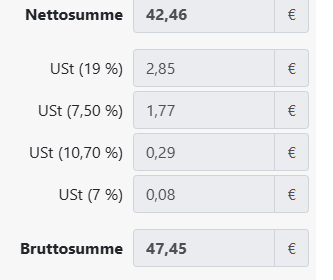
However, the change in tax rates must be correctly stated on receipts and cash receipts. With a cash register system however, it is simple and uncomplicated. Taxation must be correctly on the receipts even with mixed calculations: This is relevant when there are different prices, as is the case, for example, with cappuccino to take away or drink on site. The price remains the same on the card — as you often see — only the taxation is different, which is then reflected in the final price.
Consumers and guests are likely to notice less of the tax cut because the companies themselves are more likely to invest in higher quality personnel and service. Or simply prefer financial security.
Price stability therefore does not initially have an effect on consumer prices, but rather indirectly on service performance and the quality of food. Long term Will the Tax cut but also in The final prices are noticeable to consumers do. The sector will more competitive And will be so Economically attractive for customers stay.
Providing planning security the tax cut represents a relief for companies and therefore is also relevant for consumers in the long term because restaurants, canteens and cafés and similar companies play a central role in social interaction play.
If s such a place have to be closed people will lose important third places to go to. In particular in rural regions maintaining such spaces is important.
In addition, jobs are being lost because other companies such as outfitters, agriculture or producers from the region also depend on the value chain of a café.
Not only do classic restaurants and hotels benefit from this, but also bakeries with catering facilities, food trucks, butchers, catering companies and other catering establishments for daycare centers, schools and hospitals or even canteens. So not only the classic restaurant and hotel business, but also craft businesses.
The catering service does not include the delivery of groceries. In the regional direct marketing you can be affected by the legislative change if you have a foodtruck, a farm café, ice cream with on-site consumption or a catering service.
A catering service provides ready-to-eat food. A delivery service for groceries, on the other hand, taxes them at a flat rate of 7 or 19%, depending on the product.
With bread delivery services there is no gastronomic offer of food, which is now taxed at 7% in bakeries. Deliveries are taxed at a flat rate and, as an additional service, are based on the tax rate of the delivered product.
For food trucks and farmyard cafés on the other hand, the new regulations now apply, as the service of a farmyard café also represents a restaurant service, as is also the case with Agrarheute.
There are no changes for beverage delivery services, as the taxation of drinks remain at 19%.
In the product data within the management overview products are created and in the product category the sales tax can be defined.
The delivery or shipping fee also depends on the type of products. In the case of mixed products, the ratio of the VAT rates would be determined according to the share in the shopping cart and then transferred accordingly to the shipping costs.
Alternatively, a tax rate can be applied to the entire shopping cart, which is based on the tax rate that has the largest share of the value of the order.
FrachtPilot can also calculate the cheapest option for you. You put this under reckoning in the settings of company data . In our Help can you read more about the topic.

If prices have not changed so far, you may not have even heard of the legislative change. It is therefore also criticized that large companies are benefiting from the tax cut because they don't pass on the reduction to consumers, but increase profits for themselves. The criticism is therefore that the relief is simply not noticeable for consumers.
DEHOGA, on the other hand, points out that food in supermarkets, which is also more packaged than when eaten on site, is only taxed at 7%.
Packaging waste is most noticeable for deliveries that are subject to only 7% sales tax. The industry therefore supports the signal to reward sustainability with a lower tax rate through local consumption without packaging waste. At DEHOGA you can read more about this topic.
It is still important to differentiate between food and drinks, as the latter are subject to regular taxation. The only thing that has changed is standardization of the taxation of food to eat on site, to take away or with delivery.
Gastronomic offerings with the changes from January 2026 can also be relevant for regional direct marketing in the form of farm cafés for instance. Are you still looking for a suitable ERP system? Have a look at FrachtPilot, book a free webinar to get to know us and the software, or test FrachtPilot directly for free. We're looking forward to seeing you!