Blog
Microgreens - green trend or real superfood?
Katharina Theo Rösner

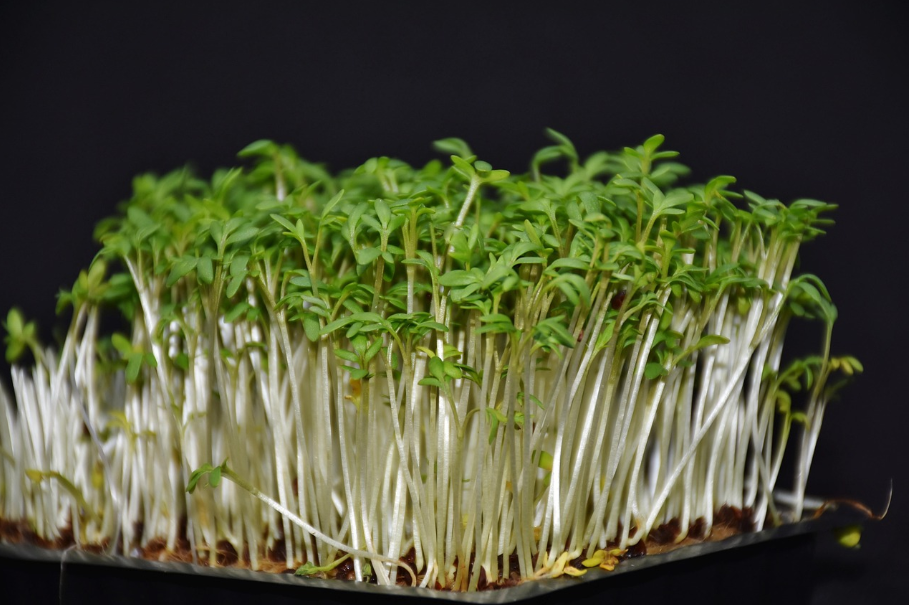

Superfood is trending, and so is everything that can be promoted as such – the greener, the better. We clarify what microgreens are, what makes them so healthy, and whether green powders are an alternative.
Microgreens are seedlings, i.e., young, edible plants of vegetables, spices, and herbs. Probably the best known is cress. But also suitable are:
They are harvested as soon as they have formed one to two leaves. This usually takes 2 to 3 weeks after germination. However, the minimum cultivation time is one week. They grow on soil or substrate.
Sprouts, on the other hand, grow in water or gel. These are also the germinated seeds that grow within a few days.
They are harvested by cutting them directly above the root. For optimal germination, they need a bright and warm location without direct sunlight.
Plants produce in the germination phase especially many phytonutrients, as you can read at gogreen-schweiz. Therefore, seedlings are rich in:
In addition to the primary components such as proteins, carbohydrates, minerals, vitamins, and fats plants also have secondary plant compounds. They need these, for example, for the defense against pests or UV light.
Bitter compounds or carotenoids are examples of these. They are partly antioxidant. Antioxidants protect cells from free radicals, which are produced by metabolic processes. They are produced in greater quantities when cells are stressed – by external influences such as alcohol or sunlight. Flavonoids protect plants from environmental influences and also have positive effects on humans. For example, they can lower blood pressure or inhibit inflammation. Antioxidants through vegetables, herbs or simply microgreens can protect cells.
An advantage of microgreens is therefore their ingredients, as plants in the germination stage contain up to three times as many vitamins as vegetables. The secondary plant compounds are 20 to 40 times more abundant than in mature plants. However, since they lack plant fibers, i.e., dietary fiber, they do not replace vegetables.
Herbs also contain dietary fiber and grow exclusively in soil, as they are mature plants whose stems and leaves can be eaten. With microgreens, only the stem and leaves can be eaten as young plants.
Microgreens are used in dressings, salads, muesli, or smoothies.
They are also available as powder available. For this, the microgreens are freeze-dried. This so-called lyophilization has the advantage that all nutrients and vitamins are preserved, thus contributing to a healthy diet.
Similar to powders made from microgreens, other green powders like AG1 are trending, which advertise that they contain all the substances that people typically lack. As dietary supplements, they do not replace food, but they can have a positive complementary effect. However, these green powders consist not only of freeze-dried sprouts but also of other green plants and algae, because green plants are rich in antioxidants .
Popular for this is wheatgrass, which actually contains less iron and vitamins than vegetables. On the other hand, many vitamins are naturally lost during heating, which is an advantage of freeze-dried powders.
Nevertheless, you should be careful when it comes to advertising with the protection against diseases , because these are generally related to a healthy lifestyle and diet. The isolated effect of dietary supplements is controversial. Because most substances are absorbed with food along with other substances, which creates interactions, so that isolated intake does not necessarily achieve the promised effect. As you can also read at AOK.
Furthermore, with a balanced diet, you absorb antioxidants even without superfoods like green powders.
Just as controversial is the aforementioned free radical theory inscience. While they could be proven, it's not clearly understood if and how they affect the cell aging process in organisms.
Microgreens and greens powders are also advertised as having detoxifying effects. However, the body has its own detoxification processes, for which the liver, among other organs, is responsible. The cells regenerate themselves, a process that can be initiated by reduced food intake.
But even when growing your own, you should pay attention to hygiene and preferably buy treated seeds that are free of germs. Here, you bear the responsibility yourself – as with all homemade things. But in return, you have full control over the quality.
Microgreens are super easy to grow at home and contain many phytochemicals with antioxidant effects. Served as a topping, all nutrients and vitamins are also preserved, so you don't need any additional powders. What you do need, however, to market your own microgreens, is an ERP system. Check out FrachtPilot ;) Test the software for 30 days for free or get to know us and the ERP system in a free webinar. We look forward to seeing you!