Blog
Vertical Farming - Alternative to conventional agriculture through these 14 advantages?
Katharina Theo Rösner

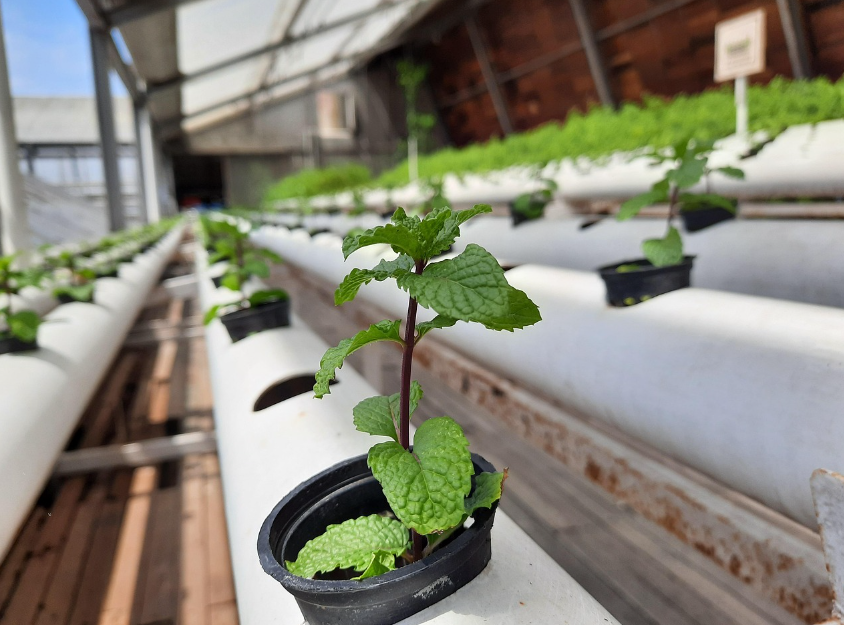

Vertical Farming in the form of hydro- or aeroponics, is considered a sustainable solution as an alternative to conventional agriculture. Plant cultivation as part of urban gardening can encounter climate challenges such as water scarcity, drought and erosion. Hydroponics as an earth-less farming method was described for the first time in 1940. NASA has researched aeroponics because it also works without gravity. In this article, you'll learn what vertical farming is and the benefits of it.
Vertical Farming describes cultivation in several layers, so on turrets or in shelves. Depending on the system, this type of cultivation is therefore not only suitable for indoor farming and urban gardening, but also for the field foil tunnel or greenhouse. Vertical farming takes the form of aeroponic towers or hydroponics which work by growing vegetables and other plants without soil.
Instead of growing on soil, the plants grow in net pots or on a substratum. The required nutrients are dissolved in water, which is supplied to the roots differently depending on the system. Since the water is supplied and recycled to the plants in a targeted manner and the plants grow in height, space and water are saved.
There are hydro, aero and aquaponic systems that only use water or air instead of soil. The system can be either open or closed. Closed systems use lamps for light providing controlled conditions, but also increases the wattage significantly. Open systems either only work with sunlight or combine this with LEDs depending on requirements or location. In addition, active and passive systems are distinguished. In the case of active ones, the water circulates through water pumps or is oxygenated by air pumps. Passive systems use less electricity, but they also quickly form algae.
The plants receive light from lamps, so that the cultivation is possible throughout the year. If only LEDs are used, day and night phases must also be created and suggested so that the plant can grow as in a natural environment.
that Nutrient medium, or substratum, is there to fix the plant and regulate the oxygen supply. It usually consists of rock wool, gravel or coconut fibers. However, it does not supply the plant with nutrients. That's what that's for water There, in which nutrients are resolved. The water circulates or the exact amount required is added.
Common farming methods include deep-water crops, the drip systems and the nutrient film technology (NFT). You can find out more about these systems at Pflanzenfabrik.
In the former, the plant is placed in a Styrofoam lid on the container with water so that the roots always hang in the water-nutrient solution. This provides them with sufficient nutrients.
Drip systems is not only available in indoor farms, but also in the open field; the method comes from Israel. As a rule, it is designed for water to seep into the soil. The plants are supplied with the nutrient solution via drops. Despite seepage, this saves water. However, in closed systems, particularly in urban gardening, the water can also be collected in a water reservoir and fed to the water circuit by a pump. Here too, the passive system becomes an active system. The plant is also fixed using a substrate.
At the NFT The plants hang with their roots in the nutrient solution, which flows through a pipe underneath. This is accordingly positioned obliquely. that Water is collected in a reservoir and fed to a circuit by a pump. More about how it works Do you read at the plant factory.
A similar system is also the aeroponics, using air instead of water. For this purpose, the plants are placed in the lid of a container, under which fog nozzles or spray nozzles lie on a pipe structure. The roots hang in the air and not in water. Here too, the water is enriched with the nutrient solution. This is achieved by the mist sprayer on the roots. The excess solution drips down and thus returns to the water-nutrient cycle. Aeroponics is the supreme discipline of possible systems. Special tower systems also form a form of aeropnics, with the plants growing in height on towers. These rotate so that the plants receive the same amount of light from all sides so that they can grow evenly.
Aquaponics also is a type of vertical farming and combines the cultivation of plants such as peppers or tomatoes with fish farming.
Due to the high power consumption the deployment has not yet reached the mainstream in Germany. Because this is due to the use of pumps and LEDs, which provide light to the plants and in doing so imitate the spectrum of sunlight, cost-intensive and above all, one reason why getting started can be difficult for companies. In Europe, the market is still in its early stages.
In 2020 Vertical Farming had a market share of 5.5 billion US dollars, in which USA was the main player. For the past four years, it has been increased by 20%. However, the potential is very high, as 129 kg can be harvested from one square meter instead of 3.9 kg per year, as you can read it at DLG.
In Dubai on the other hand, there is currently the largest vertical farm, which produces 900,000 kg of vegetables a year, like you read it at the Federal Information Center for Agriculture. The location conditions there are ideal, so to speak, because vegetables grow poorly in the desert state and have to be imported at a high cost. Imports are also more environmentally harmful due to transport routes than the local production. Through the many hours of sunshine the necessary electricity can be produced more sustainably and cheaply than in Germany, for example.
In theory, all plants can grow hydro and aeroponically. However, that is not economical for all varieties, for example for staple food. But leafy, fruit and even tuber vegetables and herbs can be cultivated in this way.
In doing so, you must note that leafy vegetables areeasier to grow than fruitful vegetables such as chili, peppers, tomatoes, and avocado because they need more nutrients. Cultivating vegetables such as carrots or potatoes, which produce their fruit underground, is also more complex. However, that does not mean that it is not possible.
commercial flowers, microgreens, i.e. edible germs, and leafy vegetables are grown. Beans, peas and cabbage as well as strawberries and blueberries are also typical. Growing lettuce and herbs is also easy. The full list can also be found at the plant factory.
There is small, ready-made hydro systems for private households, which you can set up in the kitchen, for example. They work with economical LEDs and without soil. If you're not a fan of potting soil and insects, or if you don't have a garden or balcony to plant, indoor farming can be a good alternative. All you have to do is refill the water. If potted plants require too much care for you, ready-made hydro systems can also be an alternative for you. Finished systems are more expensive to buy, but easier to assemble than systems to assemble.
Some solutions are only available for companies such as LEH: Supermarkets grow herbs and lettuce in cupboards themselves and sell them directly. This also meets the demand for Regionality. The cultivation systems are provided by B2B companies.
Other companies have focused on the commercial cultivation of plants such as micro greens, flowers, sprouts or leafy vegetables.
Alternatives to conventional farming methods are the solutions of the future and are important for climate challenges to encounter. Vertical Farming Is up to date particularly suitable for dry regions with many hours of sunshine, since the required electricity is expensive. While the largest indoor farm in Dubai is successfully producing vegetables, startups in the sector in Germany have already gone bankrupt. This is also due to the fact that cultivation is not suitable for staple food.
Open systems are also suitable for fields, greenhouses or foil tunnel - the drip system comes from agriculture - they are therefore potentially also used in regional direct marketing. Are you still looking for a suitable ERP software? Then take a look at FrachtPilot ;) You can test our ERP system for free or get to know us and the FrachtPilot in a webinar. We're looking forward to seeing you!