Blog
Returned direct debit - when and how to book it
Katharina Theo Rösner


Direct debit returns are reversals of a SEPA direct debit and occur when a SEPA direct debit transaction cannot be processed.
Possible reasons include insufficient account funds or an incorrect account number. For example, if there is a typo in the IBAN or the account no longer exists.
In the account statement, direct debit returns are displayed as a debit . The account is charged, and the money is subsequently returned in the form of a direct debit return refunded to the customer's account. This incurs fees of up to €5. These are, however, exempt from VAT. You only have to pay these fees if the reason for the chargeback is that your account lacks sufficient funds. You can read more about this on Finance.
To avoid returned direct debits, you should keep an eye on the direct debit date to ensure there are sufficient funds available. If a payment cannot be collected, you do not need to transfer the amount yourself, as the creditor will usually attempt to process the direct debit up to three times. You can read more about this at Anwalt.de .
The SEPA direct debit is one of the most common payment methodsbecause it is super simple and straightforward. The creditor collects a specific amount of money from your account as the debtor at a specific time. If the transaction fails or is contested, it results in a returned direct debit.
Business customers cannot dispute a direct debit. In the event of a direct debit reversal, the fees will be charged to you. A payment reminder is not mandatory because you are automatically in default if you miss the payment deadline. Depending on the amount, late fees may also be charged.
Direct debit reversals incur fees for you, which you can pass on to the customer. It is useful to set up a separate expense account for this purpose. However, the decision on how to manage these accounts rests with you and your tax advisor.
An expense account is created under Account Management in the company data. To do this, click on Actions > Create new expense account.

On the bank statement or in the CAMT file returned direct debits appear as debits.
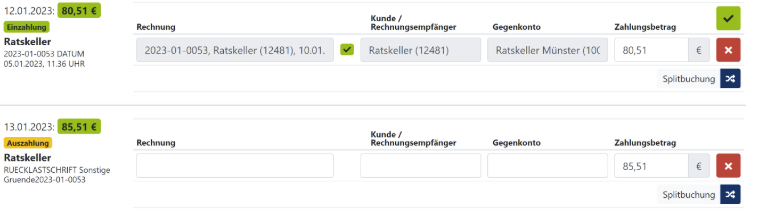
In your FrachtPilot, you will see under 'Payments' first a credit and then – usually later in the day – a debit that is €5 higher, because the bank charges fees for failed transactions.
In order to be able to invoice the fees, a virtual item must be created with 0% VAT. This must also be created beforehand if it has not yet been set up. This is done in External Settings > VAT Management.
The credit is posted with the green checkmark. For the debit, search for the invoice number in the invoice field and confirm with Enter. The invoice is then assigned to the debit and also confirmed with the green checkmark.
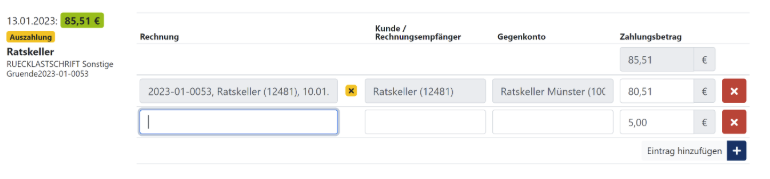
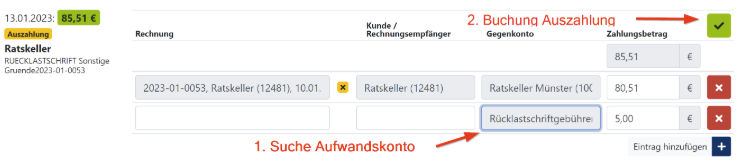
Due to the difference between the deposit and the withdrawal, the invoice is not fully settled after the entries, which opens a second line containing the fees. These must be assigned to the corresponding expense account. This is searched for in the 'Contra account' field and confirmed by pressing Enter. Click the green checkmark to post the withdrawal.
You now create an invoice about the fees by creating an order for the corresponding customer using the virtual item named e.g. direct debit return fees. Set this to self-pickup so you can create the invoice directly without having to assign it to a route.
Typically, you would then send a payment reminder. Please note that for business customers, sending a payment reminder is not mandatory. You can also charge them late fees.
You can initiate a chargeback yourself if a direct debit was incorrect or unauthorized. However, direct debits also fail if there are insufficient funds in the account. This incurs fees, which are usually passed on to the customer.
If, in addition to accounting, you are looking for top features for your regional direct food marketing, take a look at FrachtPilot, book a free webinar to get to know us and the software or try FrachtPilot for free for 30 days. We look forward to meeting you!



